
Written by Doug Katze, Electronics Business Development Manager
Design engineers are being asked to pack more functionality into smaller, more powerful electronic devices, while at the same time, maintain high reliability performance through thermal cycling, shock, vibration, and mechanical stress. As component sizes shrink and performance demands increase, underfill and edge bond materials have become essential tools for improving assembly robustness and extending product life.
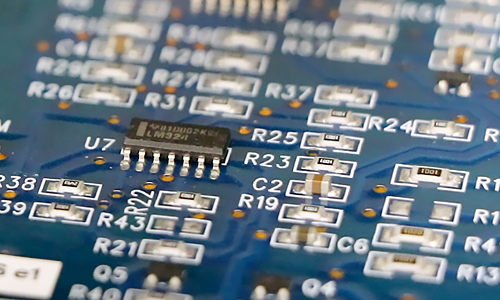
Miniaturized PCB assemblies place increasing demands on reliability and performance.
The Reliability Challenges Facing Modern Electronics
Electronic assemblies today operate in increasingly demanding environments. Devices routinely experience:
- Repeated thermal cycling
- Mechanical shock and vibration
- Board flex during assembly and use
- Mismatches in coefficient of thermal expansion (CTE) between components and substrates
- Higher operating temperatures and power densities
These conditions place significant stress on solder joints, particularly in area-array packages such as BGAs, CSPs, and flip-chip devices. As package dimensions shrink and solder joints become smaller, the margin for reliability decreases.
Manufacturers must therefore look beyond the solder joint itself and consider additional methods of stress mitigation.
What is Electronic Underfill?
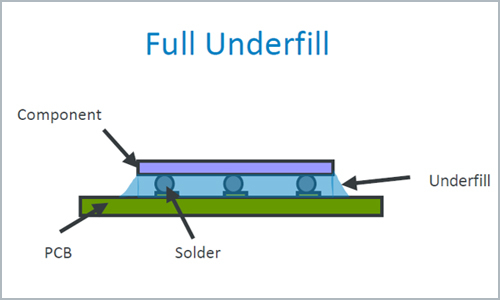
Underfill encapsulants are designed to flow beneath a component and encapsulate the space between the package and the printed circuit board. Once cured, the material creates a reinforced structure that distributes mechanical and thermal stresses more evenly across the interconnect array.
Improved Thermal Cycling Performance
Electronic assembly packages are stressed during reliability testing such as thermal cycling. Due to CTE mismatches between the circuit board, components and solder joints, stress develops as these parts expand and contract at different rates. The same amount of stress on an electronic assembly is present whether underfill is used or not. Underfill does not reduce the amount of stress, but rather, with the use of an underfill, that stress is not concentrated on the solder joints of the assembly as usual but rather is redistributed over a lager surface area created by the underfill thereby extending the reliability performance of the assembly.
Increased Mechanical Strength
Underfill strengthens the overall package attachment, helping protect components against drop impact, vibration, and mechanical shock. This occurs due to additional adhesive forces from the underfill as well as redistributing stresses away from solder joints to a larger surface area.
Enhanced Long-Term Reliability
For high-value electronics where repair or replacement is costly, underfill can significantly extend operational life and improve reliability in the field.
Support for Miniaturized Designs
As components become smaller and interconnect pitches become finer, underfill provides an additional level of protection that enables continued miniaturization without sacrificing performance.
What Is Edge Bond Technology?
While underfill offers comprehensive reinforcement, some applications require a faster, more selective, more manufacturing friendly, and a more cost-effective approach. Edge bond materials address this need by securing components at strategic locations around the perimeter rather than filling the entire gap beneath the package.
Applied at the corners or edges of a component, edge bond materials cure to create localized reinforcement that reduces stress on solder joints while minimizing process complexity.

Faster Manufacturing Throughput
Because edgebond material is only applied at selected locations, edge bonding requires significantly less material and much shorter processing times compared with traditional underfill approaches.
Reduced Material Consumption
Targeted application lowers overall material usage while still delivering substantial reliability improvements.
Improved Resistance to Shock and Vibration
Edge bond materials function similarly to underfill materials in that they extend the reliability performance of an assembly by redistributing the induced stresses from vibration, drop, or thermal shock from the solder joints to a larger surface area. This helps stabilize components and reduce movement during mechanical loading, providing valuable protection for portable and high-use electronic products.
Manufacturing Flexibility
Although underfill materials provide an extended level of reliability performance for electronic assemblies, the trade-off is underfills are not compatible with the standard SMT manufacturing process, making underfill undesirable from a manufacturing viewpoint as well as expensive as they drive up manufacturing costs. Underfill is typically provided frozen meaning syringes of underfill need to be managed in the freezer and thawed prior to use. The underfill process is then performed off-line, outside the normal manufacturing line, due to the unique steps of having to dispense on a hotplate and curing off-line in an oven for typically 30-60 minutes. This non-compatibility with the standard SMT manufacturing process drives manufacturing costs up dramatically. For many applications, edge bond materials provide an effective balance between reliability enhancement and production efficiency, making them attractive for high-volume assembly operations. UV curing edgebond in particular offers unique value to users in that they are 1-component materials, like underfill, but do not require frozen storage like an underfill. This means the thawing step is eliminated from the manufacturing process. UV curing edgebond is also compatible with the SMT manufacturing process. The process can be performed all in-line, which reduces costs compared to underfill. UV curing edgebond can be dispensed in-line, without the use of hotplates like an underfill, and can be cured in-line within seconds.
Underfill vs. Edge Bond: What's the Difference?
Both technologies improve solder joint reliability, but they achieve this goal in different ways. Understanding the tradeoffs can help manufacturers choose the best approach for their application.
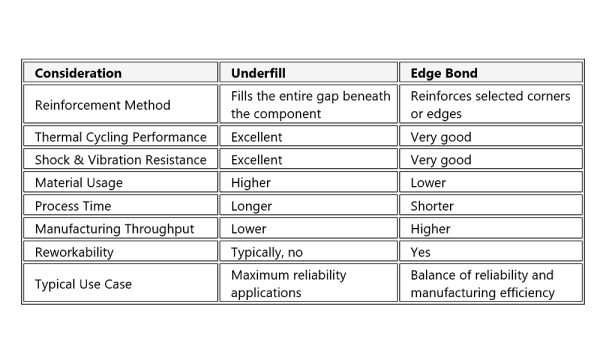
Neither solution is inherently better. The optimal choice depends on performance requirements, manufacturing priorities, component value, and lifecycle considerations.
Which Technology Offers Better Reworkability?
Reliability is only one part of the material selection process. Manufacturers must also consider what happens if a high-value component requires replacement during production or field repair.
Traditional underfill materials create a strong bond between the component and substrate, fully encapsulating all the solder joints, making component removal difficult and potentially damaging to the PCB. While this level of reinforcement is desirable for many mission-critical applications, it can complicate rework processes and increase repair costs when expensive components are involved.
Edge bond materials offer much greater manufacturing flexibility. Because reinforcement is applied only at specific locations around the component perimeter, and not encapsulating solder joints, edgebond can be removed more easily, allowing manufacturers to replace or repair components without sacrificing the entire assembly.
For applications incorporating costly processors, memory devices, sensors, AI accelerators, or specialized components, reworkability can become an important factor alongside reliability, throughput, and manufacturing cost.
How Do Underfill and Edge Bond Materials Improve Reliability?
Whether applied beneath a package or strategically around its perimeter, both technologies help address the root causes of solder joint failure.

Key reliability benefits include:
- Reduction of mechanical stress on solder joints
- Improved resistance to thermal cycling
- Enhanced durability during shock and vibration events
- Better performance in harsh operating environments
- Increased confidence in long-term product reliability
As device architectures become more compact and sophisticated, these reinforcement strategies are becoming increasingly important across consumer, industrial, automotive, telecommunications, and infrastructure electronics applications.
Choosing the Right Reinforcement Strategy
The choice between underfill and edge bond technology depends on several factors, including device requirements, environmental conditions, manufacturing objectives, and reliability goals.
When Underfill Makes Sense
- Underfill is often preferred when:
- Maximum reliability is required
- Cost is not a driving factor
- Assemblies experience severe thermal cycling
- High-value components must be protected
- Flip-chip or advanced packaging technologies are used
- Long-term durability is the primary objective
When Edge Bond Is the Better Fit
Edge bond materials are frequently selected when:
- High-volume manufacturing efficiency is critical
- Reliability improvements are needed without full underfill processing
- Cost and throughput considerations are important
- Components require protection from shock and vibration
- Reworkability may be required
- Selective reinforcement provides sufficient durability
In many cases, engineers evaluate both approaches during product development to determine the optimal balance between reliability, process simplicity, component repairability, and manufacturing cost.
Supporting the Future of Advanced Electronics
As electronic devices continue to evolve, reinforcement materials will play an increasingly important role in ensuring reliability. Whether through comprehensive stress distribution with underfill technologies or targeted reinforcement with edge bond materials, manufacturers have more options than ever to enhance assembly performance and durability.
Success ultimately depends on selecting materials that align with application requirements and partnering with suppliers that can help optimize process development, reliability testing, and production implementation.

At Dymax, we work closely with electronics manufacturers to provide light-curable, edge bond, and reinforcement adhesive solutions that help improve assembly reliability while supporting efficient manufacturing processes. For applications requiring both ruggedization and serviceability, manufacturers may benefit from reinforcement technologies designed to provide strong mechanical protection while enabling easier component rework and replacement.