
Determining Reliable Adhesive Bond Performance
Adhesive bonding plays a critical role in modern manufacturing, supporting smaller assemblies, higher performance, and long-term reliability. While advances in adhesive chemistry and processing continue to improve outcomes, adhesion failures remain common. In many cases, the root cause is not the adhesive itself, but the condition of the surface being bonded.
Dave Dworak, Material Scientist at Dymax shares his new technical paper The Science of Bonding, that examines how adhesive chemistry, processing, and substrate surface energy interact, and why all three must be aligned to achieve consistent bond performance.

David Dworak, Dymax Material Scientist
The Three Pillars of Adhesive Bonding
Reliable adhesive bonding depends on adhesive chemistry, processing, and substrate surface energy. This study shows how surface condition directly impacts bond strength and explains why water contact angle measurement is a practical method for predicting adhesion reliability. Controlled testing demonstrates that surface preparation and surface aging significantly influence bonding outcomes.
Reliable adhesion depends on three interdependent factors:
- Adhesive chemistry, which defines mechanical and environmental performance
- Process controls, including storage, handling, dispensing, and cure
- Substrate surface condition, which governs wetting and molecular interaction
While adhesive selection and processing are typically well controlled, surface condition often introduces processes variability due to contamination, oxidation, or surface aging.
Why Surface Energy Is Critical
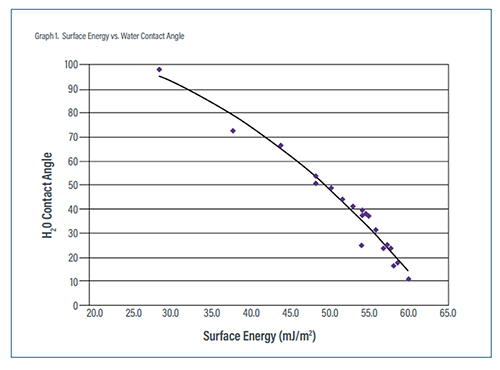
Surface energy determines whether an adhesive can properly wet a substrate. Poor wetting limits contact and weakens the bond, regardless of adhesive formulation. The white paper highlights water contact angle measurement as a practical method for assessing surface energy and predicting bond readiness. Lower contact angles correlate with higher surface energy and stronger bonds, while even small increases can indicate elevated failure risk.
Insights from a Controlled Study
To quantify these effects, Dymax partnered with Brighton Science to evaluate multiple adhesive chemistries and common substrates using contact angle measurement and lap shear testing. Results showed a clear relationship between surface energy and bond strength, as well as notable differences in how adhesive systems respond to surface preparation and aging.
Findings confirmed that:
- Untreated surfaces exhibit high variability and reduced adhesion
- Solvent cleaning improves consistency but may be insufficient
- Plasma treatment delivers the highest bond strength but decays rapidly with time
- Adhesive chemistries differ in sensitivity to surface condition
From Characterization to Process Control
The study demonstrates how contact angle testing can serve as a fast, quantitative tool for validating surface readiness in production environments. When linked to mechanical performance, these measurements enable engineers to establish objective cleanliness thresholds, reduce rework, and improve bonding reliability.
For full experimental data, test methods, and detailed recommendations, explore the white paper The Science of Bonding: Understanding the Interaction Between Adhesive Chemistry, Processing, and Substrate Surfaces to Achieve Optimal Bonding Performance.